
In many major cities around the world like New York, Hong Kong and London you will be able to hear – if you listen carefully – many different languages and dialects being spoken around you. From Thai to Tagalog, and Javanese to Japanese, they can be truly multilingual cities.
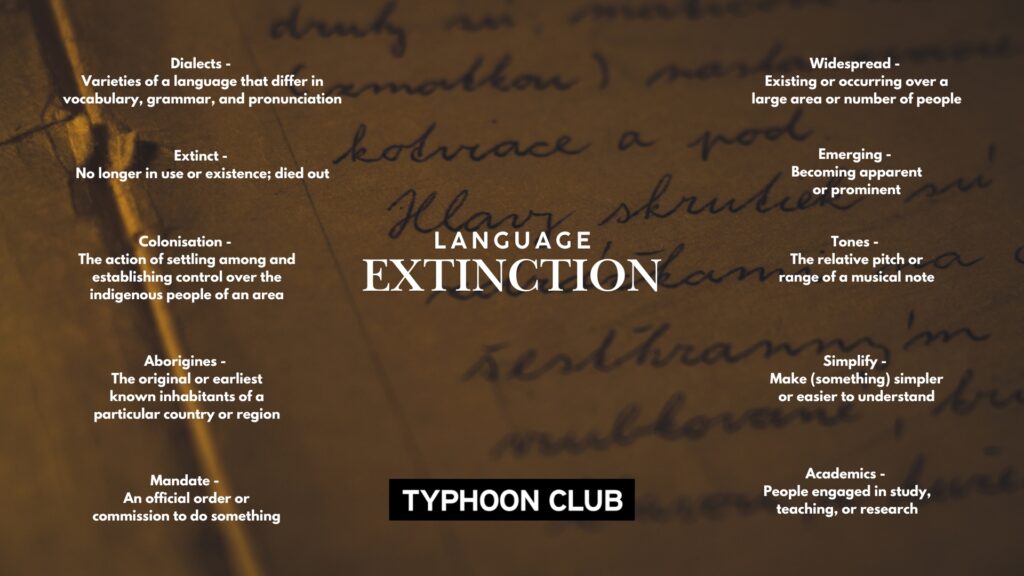
There are over 6,000 different languages spoken around the world. But the world is a fast-changing place. Academics at America’s Columbia University recently said that within 100 years, only 600 languages would be spoken on planet Earth. The other 5,400 languages existing today will have become extinct. That’s right, 90 per cent of today’s languages will soon die out.


Throughout history, people have left their homes and travelled long distances looking for work and a better environment to live in. This has usually led to them adopting the language of their new home. Languages have also been lost through colonisation. Native speakers like the Aborigines in Australia and Native Americans in North America were often punished if they continued to use their own language.
Languages in smaller countries have often been lost because parents have decided not to pass on their language to their children. Parents hope a more widely spoken language will be more useful to them. Experts at Columbia have found that once a language has skipped one generation, there is little chance of it surviving. When schools have tried to teach a dying language, the children often adapt the old language to include a more popular language. New vocabulary is created, and grammar is usually simplified.
The Big Question
The big question that many of you will be asking is, “What will become the world’s most popular language?” In recent years, the world has seen a significant growth in the number of people learning and speaking Mandarin, and of course we have seen that here in Hong Kong. China’s massive population and growing economic strength will certainly ensure that Mandarin is here to stay. But will it overtake English?

There is a general feeling among academics that English may still be the most widely spoken language in 100 years’ time and there are two reasons for this. The first is simply that English got here first. It would take a huge effort to reduce the amount of English books, Internet content, popular entertainment and education to make another language the most widely spoken. And second, as many of you will agree, the tones of Mandarin are extremely difficult to learn, especially after childhood. Hopefully here in Hong Kong we may have a head start over everyone else.
Recording rare languages before they disappear from the face of the Earth:
QUESTION:
VOCABULARY: