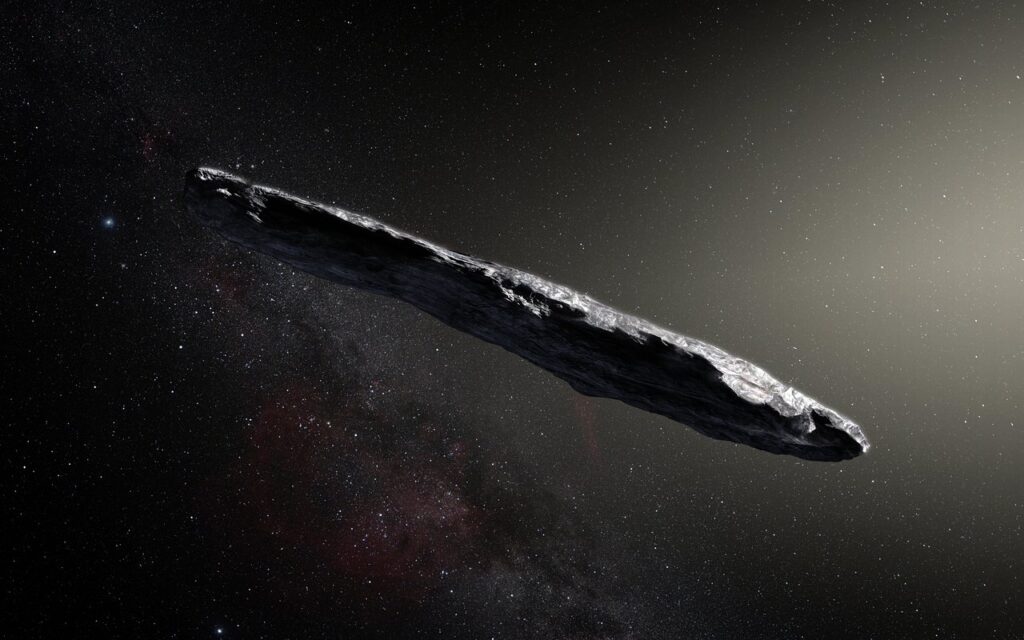
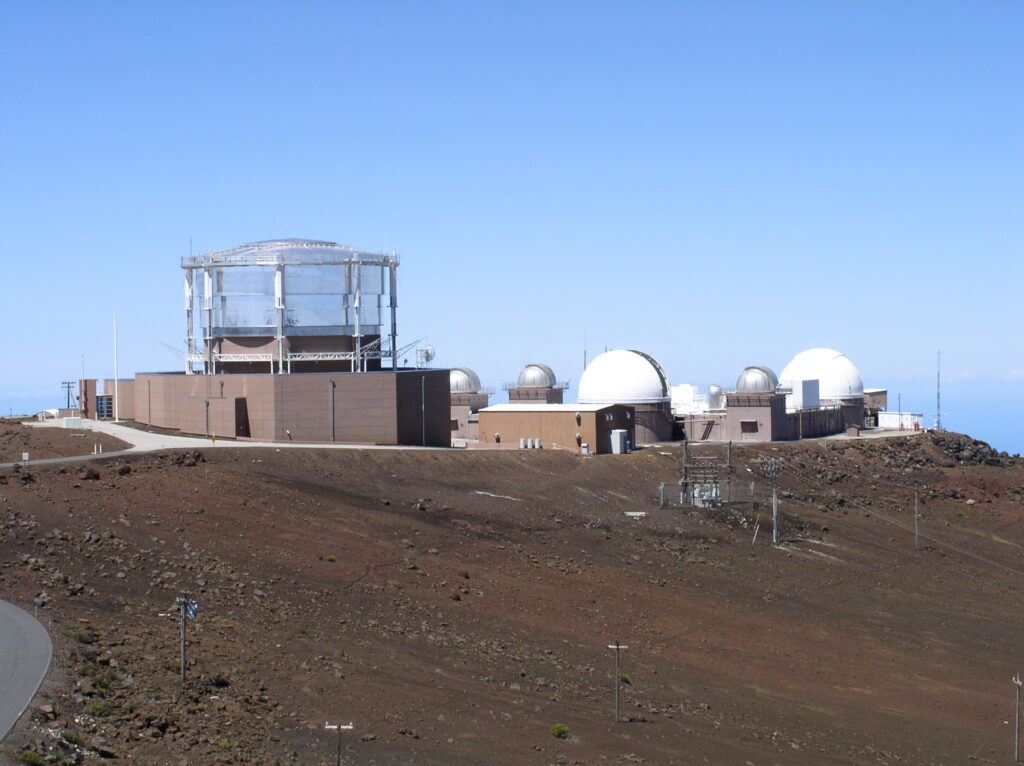
The date of 19th October 2017 will be stamped onto the memory of everyone working at the Haleakala Observatory in Hawaii. Those lucky enough to use the observatory’s high-powered Pan-STARRS telescope would see something that had never been seen before. Even though it was 33 million kilometres from the Earth, they were able to calculate that whatever it was, was 230 metres long and 35 metres wide. It was very unusual.
Scientists first thought that what they saw must be a comet and it was given the title C/2017 U1. However, a comet usually has a tail made from dust, water and ice following it. They changed their minds and said it was an asteroid. Its title was changed to A/2017 U1. Following further investigation, it was decided that it was neither a comet nor an asteroid. It was an object that had come from outside our own solar system. These are known as interstellar objects. They called it ‘Oumuamua’, which is Hawaiian for a messenger from afar. It was the first interstellar object ever seen. Scientists today, however, argue about whether or not it is a real interstellar object.
Within one week of the first sighting, 34 other observatories around the world had picked Oumuamua up. Scientists were asked to help measure its orbit, brightness and colour. One of the first things they also did was to check if it was transmitting any radio waves – it was so unusual they wanted to make sure it was not a space ship from another planet. No transmissions were identified!
It was soon discovered that Oumuamua’s journey was not a smooth one. It was, in fact, spinning wildly. Scientists came to the conclusion that it must have been involved in a collision with another hard object. It was this collision that may have thrown it away from its original solar system.
Scientists have also agreed that Oumuamua has been spinning through space for millions—possibly billions—of years. It is travelling at 38.3 kilometres per second (or 156,428 kilometres per hour). In March 2023, Oumuamua passed Neptune’s orbit and is traveling away from the Solar System. It can no longer be seen by telescope and will probably never be seen ever again – and certainly not in our lifetime.
Question:
What is the true nature of Oumuamua?
VOCABULARY